Efficient Paper Clutter Solutions You Can Start Today
Shopping links: These links open Amazon search results. They are optional browsing suggestions, not verified product reviews or price/availability checks.
Start with a paper decision, not a timed purge
Choose one manageable group of papers and a suitable place to review it without exposing private details. You do not need to gather every record in the home into one pile or compete to discard the most in thirty minutes. This guide makes no promise of stress relief or guaranteed time savings. The goal is to find what matters, protect what must remain and make the next action clear. An uncertain original can stay retained while its requirements are checked.
Separate ownership, retention and action
Ask whose paper it is, whether it must be kept and whether someone needs to do something with it. These are different questions. A current bill may need payment and later retention; a school form may need an accepted handoff before filing. Check deadlines against the original source. Do not discard another person’s papers without permission. Give an unresolved item a responsible person and a review point rather than treating uncertainty as a reason to put it in recycling.
Check the requirements for each important record
Retention depends on the document, jurisdiction, organization and any ongoing claim, dispute or obligation. Ask the relevant authority or a qualified adviser when uncertain. This guide supplies no universal period for bills, tax papers, medical records, receipts or warranties. A paper that has not been read for years can still matter. Keep records subject to a hold as required. Avoid replacing this check with a broad rule about what most people supposedly never need again.

Use simple folders without hiding active work
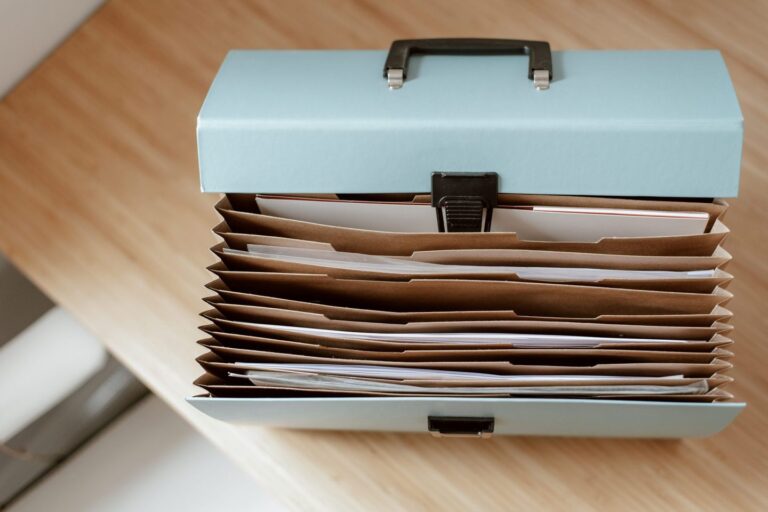
Try a small incoming group, clearly owned action papers and suitable reference categories. A label such as temporary does not determine when a paper may be destroyed. An outbox also needs a clear meaning: ready to send is different from awaiting a decision. Keep private originals in appropriate secure storage rather than an open tray near a shared front door. Use readable words; color is optional. Existing folders may be enough to begin.
Digitize only through an appropriate process
Check whether the original must remain and which digital format, if any, the intended organization accepts. Use an authorized service for work or confidential records. Inspect page order, readability, attachments and relevant reverse sides, then open the file from its intended location. Keep product, transaction or other reference information needed later. Do not shred the paper merely because a scan exists, and do not treat a cloud-service name as proof of secure storage or permanent access.
Review access and backup before relying on a file
Check the account, sharing permissions and access from shared devices. Work and client records should stay in approved locations. Understand whether a folder is synchronized and how deletion or changes affect connected devices. Establish a suitable backup and check that an authorized person can retrieve a sample. Recovery periods can be limited. A scan stored once in an online folder is not automatically a complete emergency plan for the original records.

Choose paperless services deliberately
For digital statements or bills, confirm the delivery method and who will monitor it. Keep access and any record-download requirements manageable. Check an opt-out service’s current scope, privacy terms, location coverage and any charges before submitting details; no named service is universally suitable. For suspicious mail or email, use the provider’s appropriate reporting route rather than following an unfamiliar link. Reducing incoming material is optional and should not cause important notices to be missed.
Use secure disposal without promising zero risk
After retention and authority are settled, use an appropriate secure route for sensitive papers. Shredding is not a guarantee against identity theft. Follow the shredder’s safety and loading instructions and keep children, pets, hair and loose clothing away from its opening. Recycle nonsensitive material only through an accepted local route. Do not leave private papers beside the recycling while waiting for a future review. Stop when an original’s disposal status is unresolved.
Review completed actions as well as folders
Choose a practical review point and check whether the relevant reply, signature or payment actually happened. Put supplies away and keep heavy files low, following furniture anchoring and loading instructions. The retained cable-box, desk-tray and monitor-stand links are optional category searches, not tested products or required paper-management tools. Check equipment ventilation, stable loading and a suitable screen position before using them. One clearly owned action folder and a retrievable record can be enough progress today.